How light, contrast and a little curiosity can give a game world a sense of direction.
Begin with a point of curiosity
A memorable environment gives the player something to wonder about. It might be an opening, an unusual silhouette or a change in light. The landmark does not need to explain everything. It needs to make the next few steps feel worth taking.
Use contrast with intention
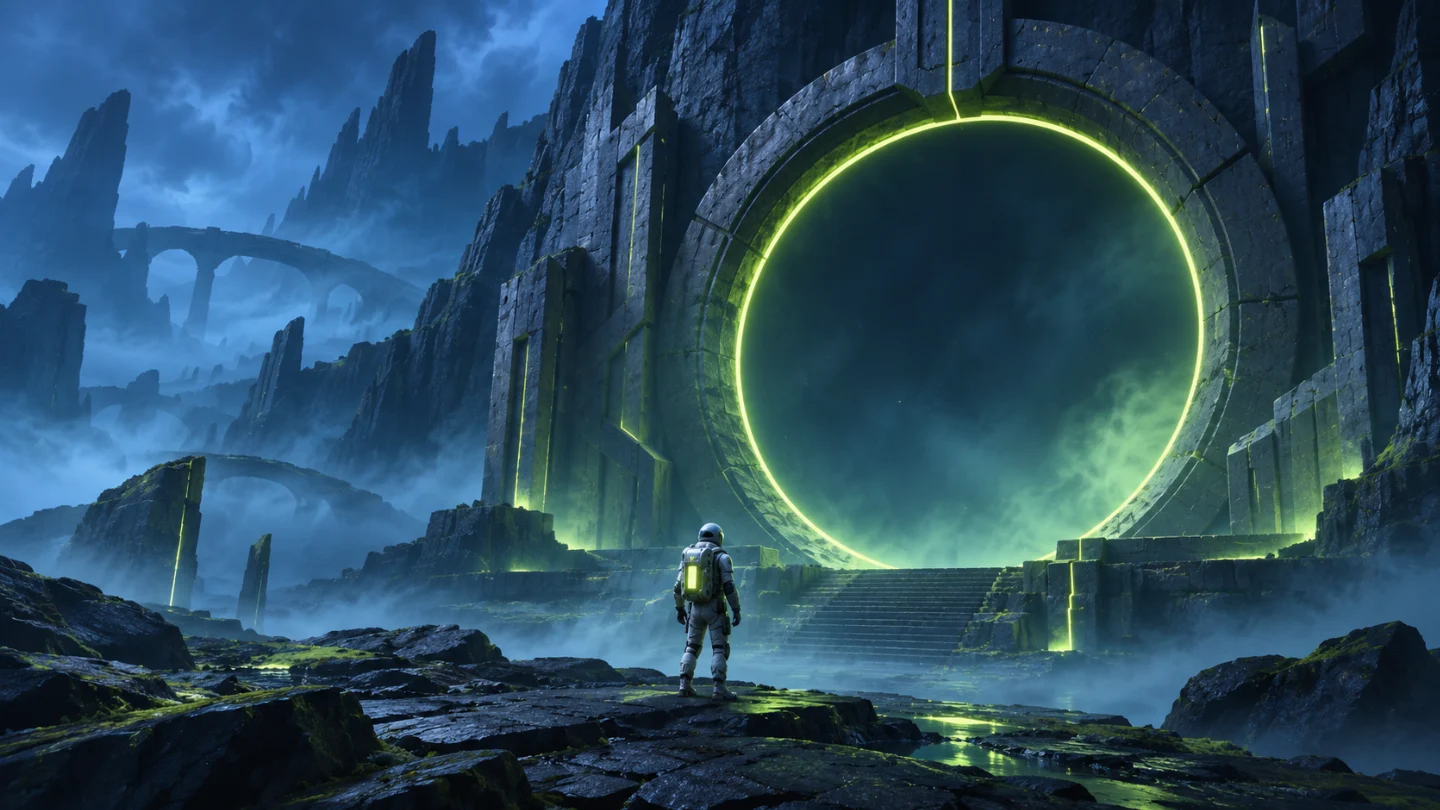
When every object is bright, nothing stands out. Limiting the accent colour gives it a role. In the Voidrun concept, cool surroundings establish the atmosphere while the lime portal becomes the visual invitation. It is a design study, not evidence of tested gameplay.
Scale tells part of the story
A small figure beside a large structure changes how the space feels. Repetition, foreground detail and distant silhouettes provide clues about distance. These relationships can suggest mystery without adding another sentence to the screen.
A beautiful image is only the beginning
A still image can explore mood and composition. It cannot prove that a level is readable in motion or that an interaction feels good. The next step would be a small playable prototype, with attention to movement, feedback and the route through the space.
Keep the question small enough to test
Instead of asking whether an entire world is compelling, start with one question: can someone find the intended destination without a marker? A bounded experiment gives a clearer direction for the next iteration.